
When looking into North American religious communities, the confusion between the Amish and Mormons arises constantly. This amalgamation leads to a recurring question: do the Amish practice polygamy? The short answer is no, and the reasons are rooted in both their theology and their community organization.
The Ordnung, an oral code that enforces Amish monogamy
The Amish rules are often mistaken for a simple folk tradition. In practice, each Amish community operates according to the Ordnung, a set of primarily oral rules, reaffirmed twice a year before communion.
This code is not limited to clothing or the use of technology. It also sets marital norms, and monogamy has been an integral part since the Anabaptist origins. The Ordnung is not a fixed biblical law but a community agreement that is regularly renewed, allowing for adjustments to certain practical details without touching the doctrinal core.
When seeking to understand polygamy among the Amish, one discovers that this question simply has no basis in their religious system. The commitment to uphold the Ordnung is made at the time of adult baptism, with the explicit understanding that its violation leads to direct consequences.
A member who enters into a multiple union would expose themselves to Meidung (excommunication and ostracism). This sanction goes far beyond the symbolic: it involves a rupture of social, economic, and familial ties with the entire community.
Amish and Mormons: why the confusion about polygamy persists
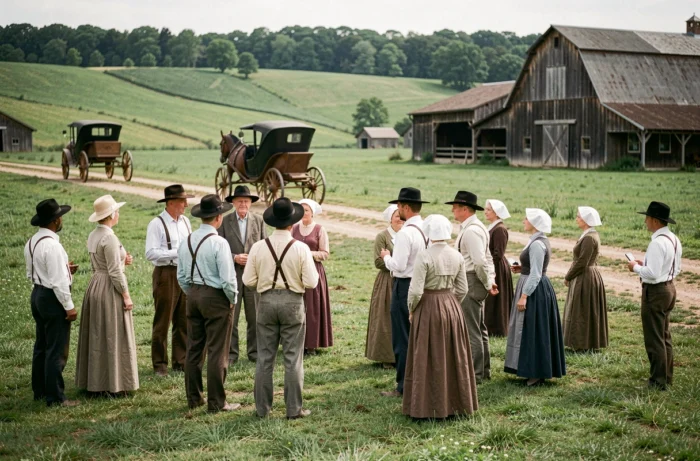
The main source of this misunderstanding is the confusion between two religious groups that have almost nothing in common. The Amish descend from the European Anabaptist movement, founded by Jakob Amman in the late 17th century. The Mormons belong to the Church of Jesus Christ of Latter-day Saints, founded in the 19th century by Joseph Smith in New York State.
Mormons historically practiced polygamy, before the mainstream Church officially abandoned it. Some dissident Mormon groups still practice it today. The Amish, on the other hand, have never integrated this practice into their doctrine, neither closely nor remotely.
Several factors contribute to the confusion:
- Both groups live in relatively closed communities, which gives an impression of opacity from the outside that is conducive to fantasies
- Strict dress codes (long dresses, bonnets, hats) create a visual amalgamation for outsiders
- Sensationalist documentaries regularly mix the two communities or suggest practices without sourcing them
In reality, the theological structure is radically different. The Amish are Anabaptist Protestants whose doctrine is based on a literal reading of the New Testament. Their view of marriage is that of an exclusive union between one man and one woman, period.
Amish marriage: how community control works
Marriage among the Amish is a process framed at every step by the community. One does not marry among the Amish as one would in American civil society.
The courtship period generally begins after the rumspringa, this phase where young adults explore the outside world before deciding whether to get baptized. Contrary to what some documentaries suggest, the rumspringa primarily serves to find a spouse, not to lead a dissolute life.
Once the couple is formed, the union must receive the approval of the community and the minister. The ceremony takes place at the bride’s parents’ home, without pomp, and the couple quickly settles into a domestic life governed by clearly defined roles.
Divorce is prohibited in almost all Amish communities. A marriage that ends poorly does not lead to a legal separation but to a cohabitation maintained under community pressure. This rigid framework excludes any possibility of polygamy, even informal, since each union is known and monitored by the entire group.
Life of Amish women and their role within the couple
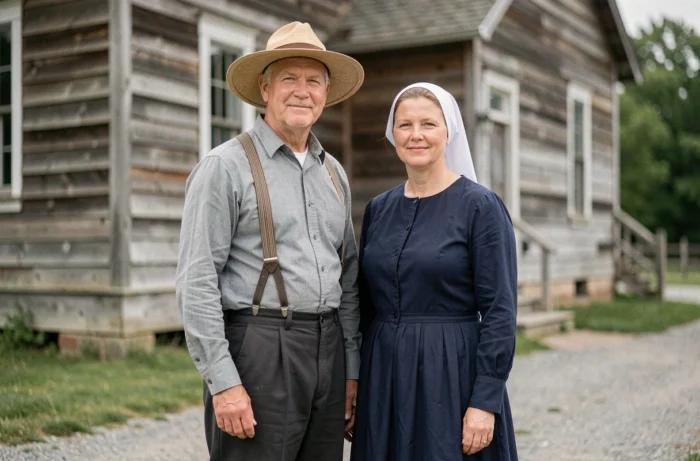
Amish women occupy a role defined by tradition: managing the household, educating children, participating in agricultural work. Submission to the husband’s authority is a doctrinal principle, not just a cultural habit.
This strict patriarchal framework should not be confused with polygamy. An Amish woman is the sole wife of her husband, and this exclusivity is protected by the community. Accounts from individuals who have left the Amish, such as Saloma Miller Furlong, describe an environment where social conformity is intense but where monogamy is never questioned.
The system operates more through collective pressure than through legal writing. Amish families often have many children, which reinforces community ties and makes any deviation visible. In groups where everyone knows each other and where movement is limited (buggy, no cars), maintaining a secret relationship is practically impossible.
Amish population and demographic evolution
The Amish community in the United States is spread across about thirty states, primarily Pennsylvania, Ohio, Michigan, and Wisconsin. Their demographic growth relies solely on internal birth rates, not on proselytism.
This rapid growth, combined with endogamy, creates documented genetic challenges. But it also confirms that the Amish family model remains strictly monogamous and centered on procreation within a unique couple.
Polygamy among the Amish is pure myth, fueled by ignorance and confusion with other American religious movements. The Ordnung, adult baptism, Meidung, and community oversight form a system where such a practice could simply not exist without being immediately sanctioned.