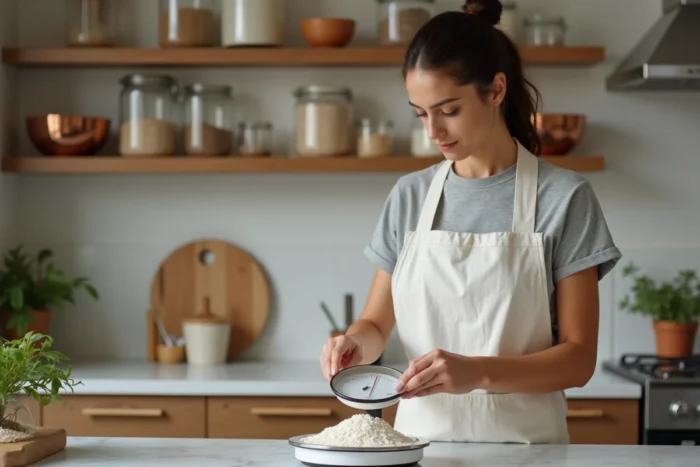
200 g of flour is poured into a graduated measuring cup in milliliters, and the displayed level does not correspond at all to 200 ml. This discrepancy is surprising every time, yet it can be explained by a single parameter: the density of the ingredient. Mastering the conversion from grams to liters prevents dosage errors that can ruin a recipe or skew a mixture.
Why grams and liters do not measure the same thing
The gram is a unit of mass: it quantifies the matter contained in an object. The liter, on the other hand, measures volume, which is the space occupied. Directly comparing grams and liters is like comparing kilometers and kilograms. We need a bridge between the two, and that bridge is called density.
The formula is straightforward: volume (in liters) = mass (in grams) / density (in g/L). For pure water, the density is close to 1,000 g/L. Therefore, 1,000 g of water occupies 1 liter. The calculation seems simple, but as soon as we change ingredients, the result shifts.
Variable density depending on common ingredients
Wheat flour, for example, weighs significantly less than water for the same volume. Granulated sugar falls somewhere in between. Olive oil is slightly less dense than water. Thus, we cannot apply the rule “1 g = 1 ml” to everything that goes through the kitchen.

Grams-to-liters conversion table for cooking
Rather than looking up the density each time, a reference table saves time. To delve deeper into the principle of this grams-to-liters conversion, here are the most useful equivalents when following recipes.
| Ingredient | Mass for 1 liter (approx.) | 1 tablespoon (approx.) |
|---|---|---|
| Water | 1,000 g | 15 g |
| Whole milk | Slightly more than 1,000 g | 15 g |
| Wheat flour | About 500 to 600 g | 8 to 10 g |
| Granulated sugar | About 800 to 850 g | 12 to 15 g |
| Oil (olive, sunflower) | About 900 g | 12 to 14 g |
| Honey | More than 1,400 g | About 20 g |
These benchmarks cover most situations encountered in cooking. Honey weighs almost three times more than flour for the same volume, highlighting how density changes the game.
Common conversion errors and how to avoid them
The first error, the most widespread, is to assume that 100 g of any ingredient equals 100 ml. This approximation only works for water and a few liquids close to its density. For flour, this confusion can add a significant excess of material in a baking recipe.
The measuring cup and spoon trap
A measuring cup measures volume, not mass. When a recipe states “200 g of flour,” filling the cup to the 200 ml mark results in a weight much lower. You end up with a batter that is too liquid without understanding why.
- Always check if the recipe expresses quantities in grams or milliliters before choosing the measuring tool.
- For dry ingredients (flour, powdered sugar, cocoa), a scale is more reliable than a measuring cup.
- For common liquids (water, milk, vinegar), the measuring cup is suitable, as their density is close to that of water.
In professional baking, the trend in recent years has been to abandon volume measurements in favor of systematic weighing. The grams-to-liters conversion then becomes a supplementary tool, not the primary method of dosing.
Watch out for the decimal point in calculations
When using the formula with density, a decimal point error alters the result. Confusing g/ml and g/L multiplies or divides by a thousand. To avoid this trap, one can standardize: always convert to grams and milliliters (same scale), then divide by a thousand to obtain liters at the end.

Online tools and manual method for converting grams to liters
Several online converters allow you to enter a weight, select an ingredient, and obtain the corresponding volume. These tools incorporate a database of densities, which avoids having to look up the density yourself.
A good converter always requires specifying the ingredient. If a tool offers a direct grams-to-liters conversion without asking about the material, the result will be incorrect for anything other than water.
Manual method in three steps
- Identify the density of the ingredient (on the packaging, a technical sheet, or a reference table).
- Divide the mass in grams by the density in g/L. For example, to convert 500 g of flour with a density of about 550 g/L: 500 / 550 gives just under 1 liter.
- Check the consistency of the result. If the volume obtained seems abnormally large or small, it is often a unit error.
In a professional context (catering, food industry), density is listed in suppliers’ technical sheets and in the Sanitary Master Plan. One does not guess the density; it is documented.
When grams-to-liters conversion is no longer sufficient
Anglo-Saxon recipes use cups and ounces, which adds an extra layer of conversion. In this case, converting first to grams and then applying the density remains the safest method.
The density of the same ingredient can also vary. Flour packed in a container is denser than aerated flour. Wet sugar weighs more than dry sugar for the same volume. Feedback on this point varies according to brands and storage conditions, reinforcing the importance of direct weighing.
The rule to remember can be summed up in one sentence: without knowing the density, any grams-to-liters conversion is an approximation. For water, the approximation is nearly perfect. For everything else, the density table and the scale remain the two most reliable allies.