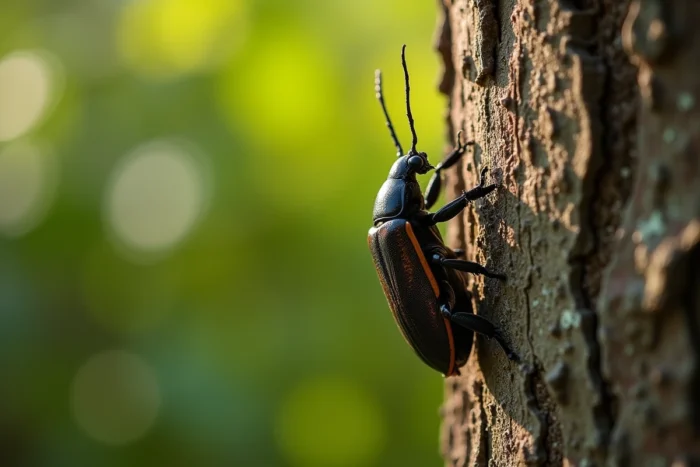
Xylotrechus chinensis is not managed like a foliar pest or a fungal disease of the plane tree. The larval galleries progress in the living wood, weakening the internal structure of the main branches and trunk, and causing mechanical breaks without any obvious external signs for several months. We regularly observe trees that appear healthy in the canopy while the wood is already largely mined.
Field Diagnosis: Distinguishing Xylotrechus chinensis from Other Wood Borers
Confusion with other cerambycids or bark beetles is common. Xylotrechus chinensis is recognized by a bundle of converging clues, not by a single isolated criterion.
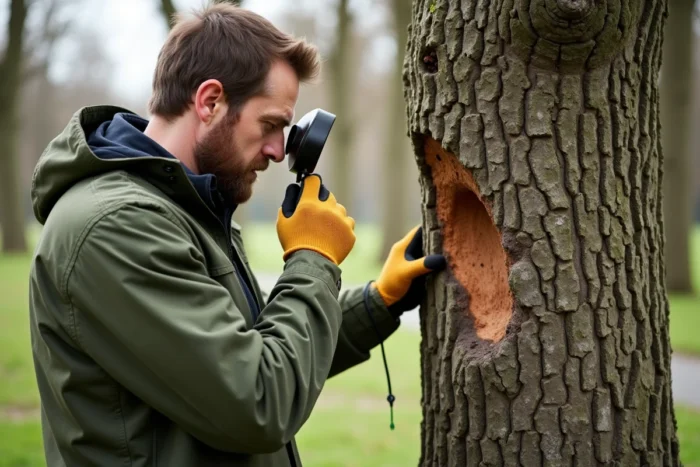
- Oval exit holes a few millimeters, oriented along the grain of the wood, often grouped on large diameter branches and the trunk. Round and regular holes indicate another borer.
- Presence of fine sawdust (pinkish to beige) accumulated in the crevices of the bark or at the base of the tree, different from the coarse sawdust produced by cerambycids of the genus Cerambyx.
- Visible adults from June to September, recognizable by their black elytra marked with zigzag yellow bands. The adult size remains modest compared to other longhorn beetles.
- Perceptible gnawing sounds when pressing an ear against the trunk or using an arborist stethoscope, especially in late spring when the larvae are active.
A single exit hole on a plane tree in a known presence area (Hérault, Gironde, Mediterranean coast) justifies a report to the regional FREDON. The species has been on the OEPP alert list since 2018, and each new outbreak must be documented.
In the event of detecting a Xylotrechus insect on the plane tree, we recommend photographing the exit holes with a reference object for scale (coin, ruler) and keeping any dead adult found at the base of the tree in a dry vial.
Sanitary Pruning of Infested Plane Trees: Common Mistakes in Summer
The usual sanitary pruning protocols for fungal diseases of the plane tree are not transposable to the tiger longhorn beetle. This is a point that we find poorly understood in the field.
Pruning an infested plane tree in the middle of summer worsens the situation. Significant cutting wounds create entry points for secondary fungi and weaken an already structurally compromised tree. Large summer cuts also increase the risk of breakage on the main branches weakened by the galleries.
The appropriate period remains the vegetative rest, between November and March. Pruning should target branches showing grouped exit holes or a detectable loss of mechanical resistance through probing (mallet, resistograph). Each removed branch must be immediately evacuated and destroyed, never stored on-site or shredded near healthy plane trees.
Disinfection of Tools Between Each Cut
The classic protocol (70° alcohol or diluted bleach) applies, but with an additional constraint: tools must be cleaned of any residual sawdust before disinfection. Sawdust compacted in the teeth of the saw can harbor fragments of eggs or young larvae.
We discourage the use of chain saws on suspect sections. A hand saw allows for better control of the cut and limits the dispersion of contaminated sawdust.
Chemical Treatment Against Xylotrechus: What Works and What Doesn’t
No approved plant protection treatment in France specifically targets Xylotrechus chinensis on ornamental trees. Contact insecticides sprayed on the bark do not reach the larvae in their deep galleries.
Trunk injection treatments (endotherapy), sometimes proposed by service providers, have not been validated by published scientific studies on this species under real conditions. Endotherapy remains experimental against the tiger longhorn beetle, and field feedback is contradictory.
In practice, management relies on three non-chemical levers:
- Felling and destruction of heavily infested trees (several dozen exit holes, proven loss of mechanical structure).
- Increased monitoring of neighboring plane trees within several hundred meters, as adults are poor flyers but capable of colonizing nearby trees.
- Replacement with non-host species during replanting. The white mulberry is as sensitive as the plane tree. Apple, pear, and vine are among the reported secondary hosts.
Reporting to Authorities: Obligation and Reporting Circuit
The regulatory status of Xylotrechus chinensis has evolved since its first detection in France in 2018 (Sète in Hérault, Le Bouscat in Gironde). Outbreaks were subsequently confirmed in Bègles and Gradignan in 2019.
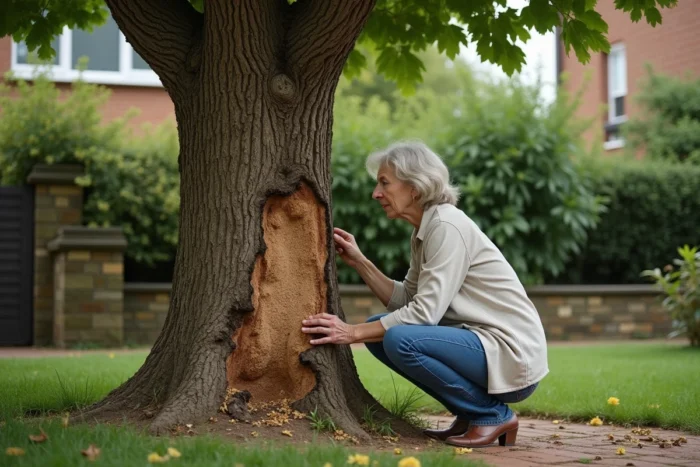
Any suspected outbreak must be reported to the FREDON of your region or to the regional food service (SRAL/DRAAF). Reporting triggers a confirmation visit and, if necessary, a surveillance perimeter.
Not reporting an outbreak for fear of imposed felling is counterproductive. Early detection remains the only effective lever to limit the spread at the neighborhood or municipal level. Communities managing alignments of plane trees have a direct interest in organizing annual inspection rounds between June and September, the period of adult emergence.
The plane tree remains a valued tree for its dense shade in urban environments. Its vulnerability to the tiger longhorn beetle now requires integrating this risk into the choice of species for any planting or tree heritage renewal project.