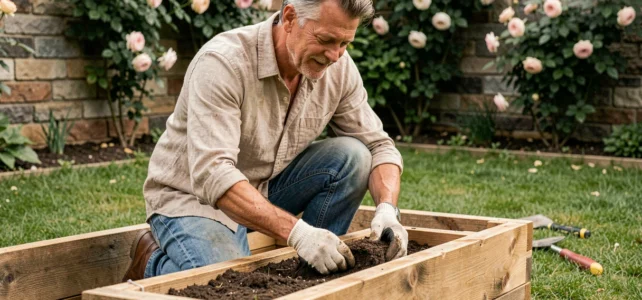
The wood used outdoors does not behave like indoor wood. Exposed to UV rays, humidity cycles, and temperature variations, it can gray, crack, or swell depending on the species chosen and the treatment applied. Enhancing a garden with wood requires mastering these technical constraints before considering aesthetics.
Use Class and Natural Durability: The Technical Foundation of Wood in the Garden
Before selecting a species for a terrace, border, or raised bed, the first data to check is its use class. This system (classes 1 to 5) defines the level of moisture exposure that the wood can withstand without additional treatment. A sheltered cladding falls under class 3, while decking in direct contact with damp soil requires class 4.
Natural durability varies greatly from one species to another. Oak, black locust (false acacia), or chestnut naturally resist in classes 3 to 4. Softwoods like pine or spruce, on the other hand, require autoclave treatment to achieve the same resistance. A French standard (PR NF B50-105-3) is currently being developed to specify the preservation specifications for treated woods and the associated treatment certification.
To delve deeper into the choice of species and their uses in the garden, the Guide Du Bois & Jardin details the technical characteristics of each family of wood suitable for outdoor use.
The Rule of Two or Three Materials for a Cohesive Wooden Garden
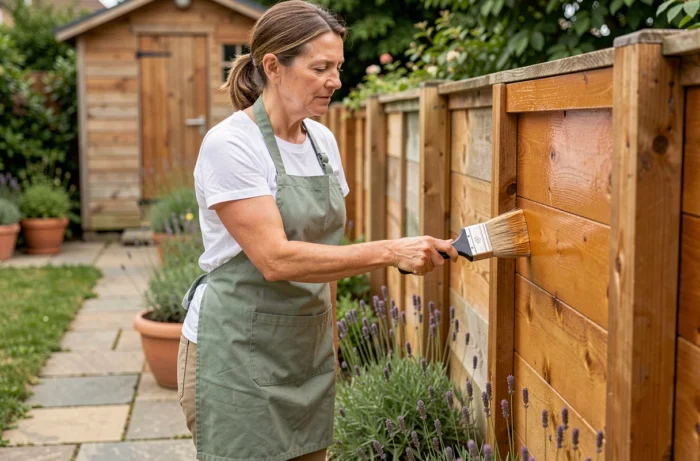
The most successful outdoor design projects share a simple compositional principle: limit the palette to two or three materials. Wood and mineral, wood and metal, wood and gravel, but rarely all four together. This intentional constraint creates a visual continuity between the house facade and the garden.
The current trend, driven by dry gardens and contemporary gardens, reinforces this logic. Wooden terraces extend the interior floor with the same shades and textures. A weathered pine deck pairs well with light stone slabs, while a raw Douglas pergola interacts better with crushed gravel than with tiles.
A common mistake is to mix wood species in the same space. Combining oiled teak, greenish autoclaved pine, and anthracite gray composite in a modest-sized garden creates a disjointed effect. A single dominant species, varied across several elements (deck, planter, screen), unifies the whole.
Treatment and Protection of Outdoor Wood: What Has Changed Since 2024
The treatment of outdoor wood is not limited to applying a coat of stain in the spring. There are two distinct approaches: preventive treatment (autoclave, fungicidal soaking) applied before installation, and maintenance treatment (saturator, oil, gray remover) performed periodically.
Since January 1, 2024, the professional use of wood protection products (category TP8) is regulated by a specific Certibiocide certificate, distinct from that used for disinfectants or pesticides. This certificate, valid for five years, stems from European regulation 528/2012 and the amended decree of October 9, 2013. A craftsman who installs a terrace and applies preventive treatment must hold the correct certificate.
For individuals, the practical consequence is direct: ask your provider for proof of this certificate before any autoclave or fungicidal treatment on outdoor wood.
Regular Maintenance Without Biocidal Products
Oil-based saturators and oxalic acid gray removers do not fall under biocide regulations. They remain accessible to individuals without constraints. A saturator applied once or twice a year on a softwood terrace slows graying and limits surface moisture absorption.
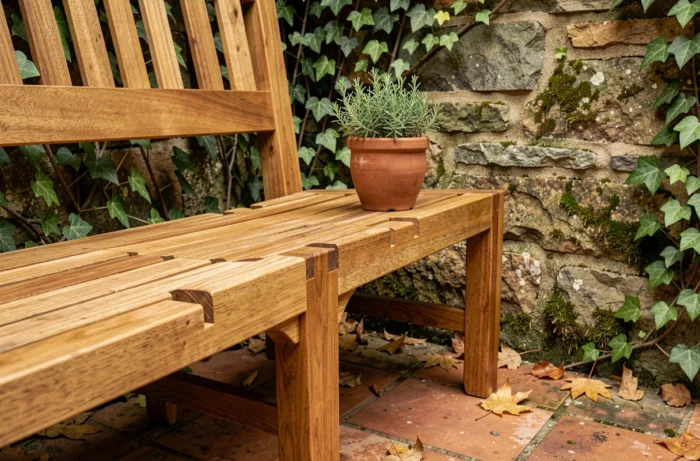
High-pressure cleaning, often done reflexively, damages the fibers of soft wood. A simple scrubbing with soapy water and a stiff brush is sufficient in most cases.
Raised Wooden Garden Bed: The Trap of Cheap Species
Wooden raised garden beds are among the most popular installations. Their lifespan depends almost exclusively on the choice of species. Untreated pine or fir boards, commonly found in large stores, degrade within a few seasons when in contact with damp soil.
- Larch, naturally resistant in class 3, offers a good compromise between cost and longevity for a raised bed without permanent contact with the soil.
- Douglas fir, available locally in several French regions, has a natural durability comparable to larch, often at a lower price.
- Chestnut, very dense and rich in tannins, naturally resists fungi. It is the most durable species for a garden bed in direct contact with the soil, but its cost and availability vary by region.
A raised garden bed made of class 4 treated autoclave wood remains a viable option, provided that the treatment product is compatible with food use. Copper-based treatments (such as CBA or CCB) are debated for vegetable crops. Choosing a naturally durable species avoids this question.
Installation Mistakes That Reduce the Lifespan of Wood in the Garden
Wood works. It swells with moisture and contracts when drying. Two installation mistakes frequently recur and reduce the longevity of installations.
The first concerns ventilation under terraces. On a large surface, moisture accumulates under the boards and causes premature warping. Integrated ventilation grilles around the perimeter of the structure allow sufficient air circulation to limit this phenomenon.
The second mistake is mixing species between boards and joists. A board made of exotic wood placed on a softwood joist creates a differential in expansion. The two woods do not work at the same rate, generating mechanical stress on the fasteners. Using the same family of species for both the boards and the supporting structure remains the most reliable practice.
A final often-overlooked point: direct contact between wood and a masonry surface retains water through capillarity. Inserting spacers made of rot-resistant material between the joists and the concrete slab is enough to cut off this moisture rise.
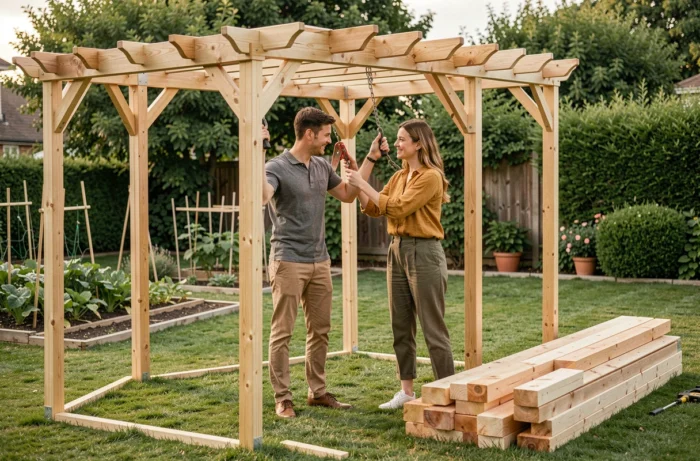
Wood in the garden rewards those who choose the species suited to the actual use, not the lowest budget. A raw black locust without any treatment will last longer than poorly ventilated autoclaved pine. The durability of an outdoor wooden installation is determined before installation, at the time of species selection and structure design.