
An espresso is based on a simple principle: forcing hot water under pressure through a disc of finely ground coffee in just a few tens of seconds. The expected result is a concentrated drink topped with a layer of golden crema. Reproducing this result at home requires understanding a few technical variables and adjusting them methodically.
Thermal stability of the espresso machine: the overlooked variable
Most guides on making espresso at home focus on grind size, dose, and tamping. These parameters matter, but they become secondary if the water temperature fluctuates during extraction.
A machine whose boiler or thermoblock does not maintain a constant temperature produces inconsistent cups from one attempt to the next. Thermal stability determines the consistency of each extraction. An under-extracted coffee (water too cold) will be acidic and flat. An over-extracted coffee (water too hot) will be bitter and astringent.
On home machines with thermoblocks, the temperature can vary significantly between the first and second consecutive cup. A useful habit is to run a short cycle of hot water through the machine before starting the actual extraction. This preheats the group and stabilizes the temperature of the circuit. On espresshome.com, different categories of machines are presented with their heating systems, which helps compare technologies before purchase.
Machines equipped with a single brass or steel boiler generally offer better thermal inertia than entry-level thermoblocks. For those preparing multiple cups per day, this difference is directly felt in the cup.
Water quality for espresso: an underestimated lever
Water makes up almost the entire volume of an espresso. Its mineral composition has a direct impact on perceived acidity, body, and the aromas extracted from the coffee. Yet, this is a parameter rarely addressed in preparation guides.
Water that is too hard stifles aromas and accelerates limescale buildup in the machine’s circuit. Conversely, water that is too soft (low in minerals) results in a bland espresso with no mouthfeel.
- Highly chlorinated tap water alters the taste of coffee: filtering it with a carbon filter pitcher is enough to remove chlorine residues.
- Low-mineral bottled waters work well, provided the total dissolved solids remain moderate.
- Distilled or reverse osmosis water should be avoided as is: without minerals, the extraction lacks body and complexity.
Testing two different waters with the same coffee, dose, and grind reveals sometimes surprising taste differences. This is one of the simplest adjustments to make without changing your equipment.
Grind size and coffee dose: the pair to calibrate together
The fineness of the grind and the amount of coffee in the portafilter form an inseparable pair. Changing one without adjusting the other disrupts the extraction.
A grind that is too fine for a given dose blocks the passage of water and produces an over-extracted, bitter espresso with a very slow flow rate. A grind that is too coarse allows the water to pass through too quickly: the result will be watery, without crema, and with pronounced acidity.
Adjusting the grind by flow time
The flow time serves as a practical benchmark. For a double espresso, the goal is generally a few tens of seconds between the start of the pump and the end of the extraction. If the coffee flows too quickly, the grind is too coarse. If it drips, it is too fine.
A burr grinder (conical or flat) allows for gradual adjustments that blade grinders do not permit. The grinder is at least as crucial as the machine itself. A good grinder paired with a modest machine often yields better results than the reverse.
Tamping: firm and even
Tamping compacts the coffee puck in the portafilter so that the water passes through it evenly. The pressure applied must be consistent from one preparation to another. What matters more than brute force is horizontal alignment: a tilted puck creates a preferential passage where the water rushes through, leaving part of the coffee under-extracted.
Pre-ground and decaffeinated coffee: practical use cases at home
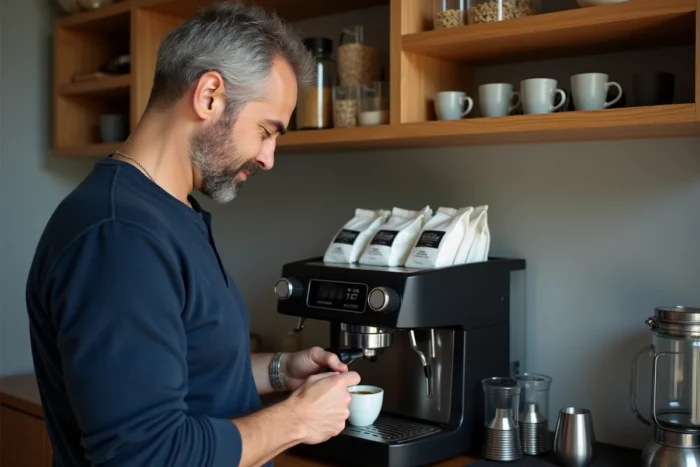
Espresso guides often target users equipped with a grinder, but many home machines have a compartment for pre-ground coffee. This detail changes the game on a daily basis.
The pre-ground compartment prevents the need to empty the bean hopper to occasionally prepare a decaf or coffee of a different origin. This is a common use case in a household where multiple people drink coffee, each with distinct preferences.
Pre-ground coffee loses its aromas quickly after opening. To limit oxidation, store it in an airtight container, away from light and heat, and consume it within days of grinding. Coffee ground for several weeks will not produce satisfactory crema, regardless of the machine used.
Maintenance of the espresso machine: what changes the taste over time
Residual coffee oils accumulate in the group, portafilter, and seals. After a few weeks without cleaning, these deposits become rancid and add a bitter off-flavor that even excellent beans cannot mask.
- Rinsing the portafilter with hot water after each use removes fresh grind residues.
- A cleaning cycle with a suitable detergent (tablet or powder for espresso machines) once a week dissolves oxidized oils.
- Regular descaling protects the boiler and internal circuits, and maintains flow rate and extraction temperature.
An espresso that gradually becomes more bitter or dull often signals a maintenance issue rather than a defect in the coffee. Before changing beans or adjusting the grind, cleaning the machine should be the first reflex to adopt.
The consistency of a good espresso at home relies less on expensive equipment than on mastering a few interrelated variables: stable temperature, suitable water, calibrated grind, and a clean machine. Each adjustment taken in isolation may seem trivial, but their combination makes all the difference in the cup.