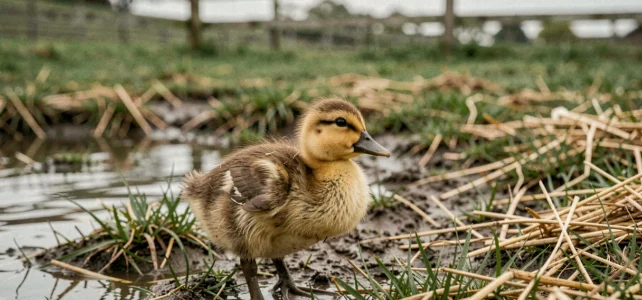
A duckling does not become an adult on a fixed date marked on a calendar. The transition to adulthood depends on specific physical markers, notably the acquisition of functional plumage and the ability to fly, which vary by species and breeding conditions.
Functional plumage and flight: the true markers of a duck’s independence
Unlike a simplistic reading in weeks, a duck’s independence is measured by three concrete abilities: feeding itself, thermoregulating with a complete plumage, and flying short distances. As long as these three criteria are not met, the duckling remains dependent.
The down of the first days does not protect against cold or moisture. It is the gradual replacement of this down with waterproof feathers that constitutes the true physiological threshold. A poorly feathered duckling placed outside remains vulnerable, even if it has reached a certain number of weeks.
In the mallard, flight generally occurs around 50 to 60 days. It is at this moment that the bond with the mother naturally breaks. Separation occurs at the time of flight, not at an arbitrary age. To determine at what age a duck is an adult, one must observe its plumage and mobility rather than count the days.
Differences between species: mallard, Muscovy duck, and domestic breeds
Not all duck species go through the same stages at the same pace. Grouping all ducks under a single growth calendar would be a mistake.
Mallard
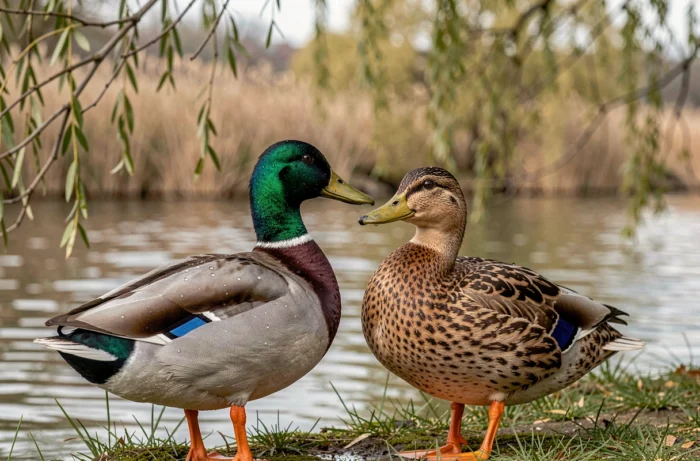
The mallard is often the default reference. Its ducklings achieve the ability to fly between 50 and 60 days. Sexual maturity occurs during the first year. The male’s breeding plumage (characteristic green head) appears in the autumn following birth.
Muscovy duck
The Muscovy is significantly larger than the mallard. This larger size extends the growth period. Males, heavier than females, take longer to acquire complete plumage and to fly. The weight difference between males and females is, in fact, a reliable criterion for sexing in this species.
Domestic breeding breeds
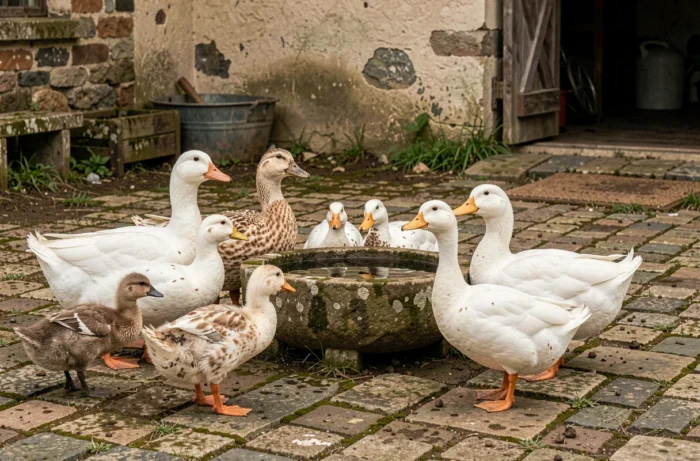
Breeds selected for meat (Pekin, Rouen) reach their adult weight relatively quickly, but their ability to fly is often reduced or even non-existent. Independence is then defined differently: the ability to feed itself, to hydrate properly, and to withstand outdoor conditions without an artificial heat source. In breeding, a duckling is considered independent when it no longer needs a heat lamp, which corresponds to the time when the waterproof plumage is in place.
Outdoor placement of ducklings: a common mistake in breeding
Placing ducklings outside too early remains one of the most common mistakes, whether in amateur breeding or among individuals who take in ducklings. Feedback converges on one point: a duckling should only go outside once it is well-feathered.
Before this stage, the down absorbs water instead of repelling it. A wet duckling loses its body heat very quickly. Access to a body of water, as tempting as it may be, can be dangerous if the young duck has not yet developed the uropygial gland that waterproofs its plumage.
- Check that the down has been replaced by feathers all over the body, including the belly
- Observe the duckling’s reaction to water: if it sinks or gets wet quickly, it is not ready
- Maintain a heat source available as long as nighttime temperatures drop below a comfortable threshold for the species concerned
- Only gradually remove the heat lamp, reducing the duration of use over several days
In practice, most breeders consider that a duckling is fit to live outside permanently between six and eight weeks, depending on the species and the season.
Sexual maturity of the duck: a second threshold after physical independence
Physical independence (plumage, flight, feeding) does not coincide with sexual maturity. These are two distinct stages, often confused.
In most domestic species, sexual maturity occurs during the first year of life. Females begin laying their first eggs several months after acquiring their adult plumage. The start of laying depends on the photoperiod: hens born in spring often lay for the first time at the end of the following winter, when the length of the day increases.
Recognizing a sexually mature duck
- In the male mallard, the breeding plumage (iridescent green head, brown-red chest) is the visible sign of reproductive maturity
- In the Muscovy duck, the red caruncles around the beak develop as the male reaches maturity
- In females, the start of laying is the most reliable marker
A duck can therefore be physically independent for several months before being reproductive. Full adulthood combines physical independence and sexual maturity, two stages that do not occur simultaneously.
Life expectancy and aging: beyond the question of adulthood
Once adult, a domestic duck lives on average about ten years in good conditions, sometimes longer depending on the species. Wild ducks have a shorter life expectancy due to predation and climatic hazards.
Determining the age of an adult duck by sight remains difficult. The plumage provides some clues: the feathers of an older duck may appear duller, and the legs lose flexibility. In banded species, the band remains the most reliable means.
The condition of the beak and legs, the liveliness of movements, and the quality of laying in females allow for a rough estimate of whether a duck is a young adult or older, without ever giving a precise age to the year.
The transition from duckling to adult duck does not therefore follow a unique calendar. Observing the plumage, flight ability, and feeding behavior remains more reliable than relying on a theoretical number of weeks, especially when the species and breeding conditions vary so much from case to case.