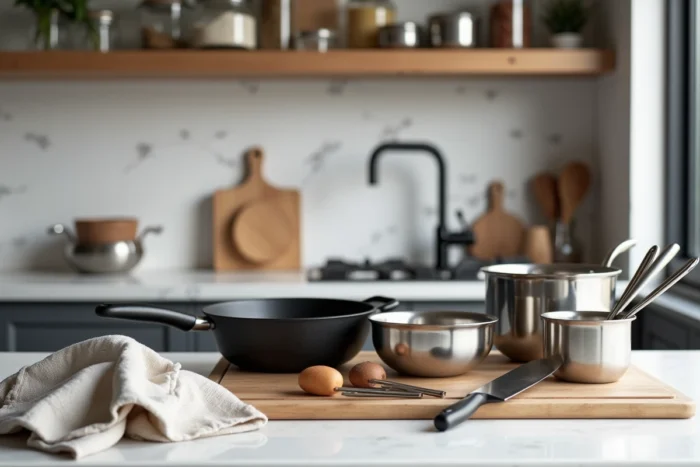
On a Sunday evening, we prepare a pie crust, and the rolling pin doesn’t glide well because the countertop is cluttered with three appliances we never use. Kitchen equipment is not judged by the number of utensils stored in drawers, but by what we actually take out when cooking. Equipping your kitchen well means choosing a few pieces, choosing them wisely, and especially adapting them to the recipes we prepare daily.
Multipurpose utensils: fewer items, more space on the countertop
In an urban kitchen where space is limited, stacking frying pans, sauté pans, woks, and stockpots makes no sense. You gain more by choosing a high-quality stainless steel stockpot that can go from low heat to the oven and withstand deglazing without flinching. This single container replaces three pots for stews, vegetable cooking, and even some pastries.
The trend towards multipurpose utensils is driven by a concrete reality: kitchens are shrinking, and every centimeter of storage counts. It’s better to have a mandoline with several cutting thicknesses than a drawer full of specialized graters. By browsing all the equipment offered by À Nos Petits Fourneaux, you quickly spot pieces that combine multiple functions without sacrificing cutting or cooking quality.
A good multipurpose utensil is recognized by its real versatility, not by a marketing promise. If you don’t use it at least three times a week, it clutters more than it serves.
Frying pans and pots: choosing the right material for your cooking
It’s often said that everything should be bought in stainless steel. In practice, it’s more nuanced. Stainless steel excels for long cooking, sauces, and deglazing: it doesn’t react with acidic foods and can withstand high temperatures. For searing meat or making a stock, it’s the go-to material.
Non-stick, on the other hand, remains the logical choice for delicate cooking. A fried egg, a thin crepe, a fish fillet that sticks to everything: without a non-stick coating, these preparations require much more fat and vigilance. The ideal is to have one pan of each type rather than three identical pans of different diameters.
Selection criteria that really matter
- The thickness of the base: a thick base distributes heat better and avoids hot spots, especially on induction cooktops
- Compatibility with your cooking source: not all pans work on induction, check the label before purchasing
- The empty weight: a pan that is too heavy tires the wrist and discourages daily use, especially for sautéing vegetables
- The quality of the rivet or weld of the handle: this is the first weak point on entry-level equipment
Reviews vary on the lifespan of non-stick coatings, but proper maintenance (no metal, no automatic dishwasher) significantly extends their effectiveness.
Kitchen knives: invest in a blade rather than a complete block
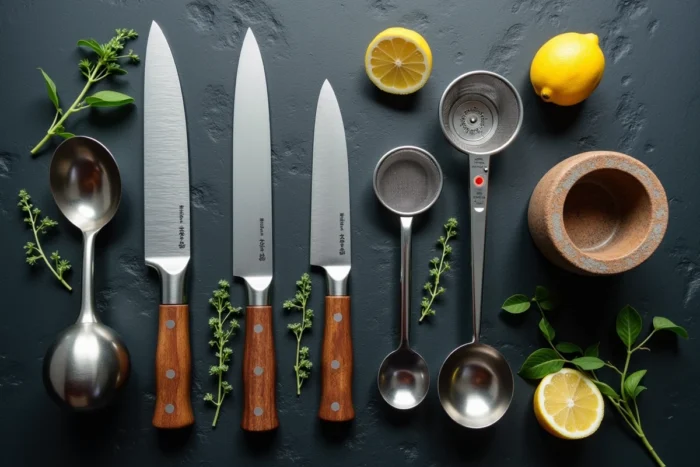
Blocks of six knives sold in sets are appealing, but you end up using only two. A 20 cm chef’s knife covers most cutting tasks: slicing onions, cutting vegetables, slicing meat. In addition, a short-bladed paring knife is sufficient for peeling and detailing small ingredients.
The real quality factor is the steel of the blade. A hard steel retains its sharpness longer and requires less sharpening. You can identify this data by the Rockwell hardness indicated by the manufacturer: the higher it is, the longer the edge lasts.
Maintaining the sharpness daily
A poorly maintained knife cuts less well than a low-end knife that is well sharpened. Running the blade over a honing steel before each cutting session maintains the edge without wearing down the steel. Sharpening on a stone is done a few times a year depending on usage intensity.
Storing knives in a drawer without protection damages the edge in a few weeks. A wall-mounted magnetic strip or felt blade guards solve the problem without taking up space on the countertop.
Connected utensils: gadget or real gain in the kitchen
Bluetooth cooking probes and connected scales with guided recipes are multiplying in the market. Their promise: precise temperature control and step-by-step guidance that reduces failures. For cooking meat in the oven, a connected probe indicates the core temperature in real-time on the phone, which avoids cutting the piece to check.
Connected equipment makes sense when it solves a recurring problem. If you regularly fail to cook a roast or hesitate about proportions in baking, a guided scale or probe can concretely change the outcome. However, connecting a timer or a kettle doesn’t add much compared to their classic versions.
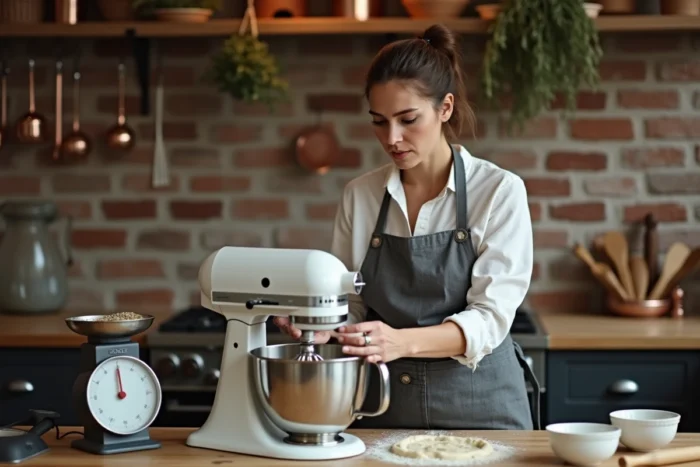
Multifunction robots controlled by an app combine kneading, cooking, and blending. They are suitable for households that cook daily with varied recipes and lack space to store multiple separate devices. For occasional use, a good immersion blender and a pot are sufficient.
Small pastry equipment: what changes the final result
In pastry, precision weighs more than power. A scale accurate to the gram and a reliable kitchen thermometer transform results more than a state-of-the-art robot. Failed caramel, collapsing meringue, chocolate that blooms: these failures almost always stem from a temperature or dosage discrepancy.
A stainless steel mixing bowl, a hand whisk, and a silicone spatula complete the kit without cluttering. A rolling pin remains useful, but it can be replaced by a glass bottle filled with cold water for doughs that require low-temperature rolling.
- Precision scale: essential for pastry recipes where 10 grams change the texture
- Probe thermometer: allows checking the temperature of a syrup, caramel, or ganache without approximation
- Heat-resistant silicone spatula: useful for scraping bowls and mixing hot preparations without scratching containers
Equipping your kitchen well doesn’t require an extravagant budget or a bottomless cupboard. A few quality utensils, adapted to what you actually prepare, are worth more than ten stacked gadgets. The equipment that stays on the countertop because you use it every day is what deserves its place.