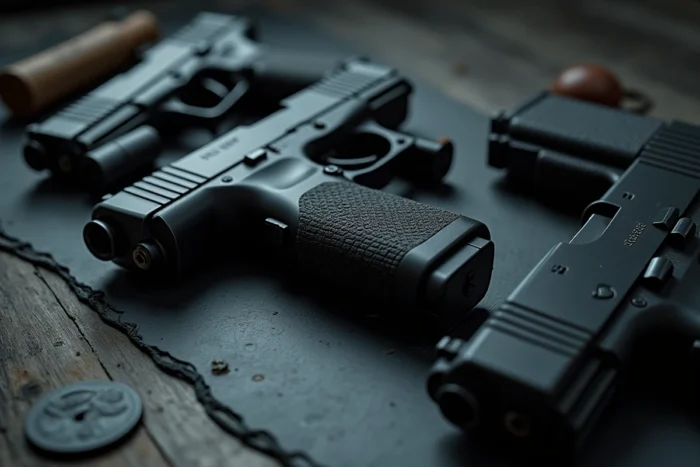
When looking at the opening scene of the first John Wick, the choice of the HK P30L is far from trivial. Chad Stahelski and his team of armory experts selected each weapon to fit a specific combat situation, not to fill a catalog. The result: a character whose arsenal evolves from film to film, dictated by the tactical constraints of each sequence.
The gun-fu according to Stahelski: when the weapon dictates the choreography
Weapons in John Wick are often talked about as accessories, but they function more like dance partners. The concept of gun-fu blends shooting and martial arts in a fluid sequence, where each reload, each transition from one weapon to another is part of the choreography. Chad Stahelski, a former stunt coordinator, built his action scenes around this logic.
The director does not choose a weapon for its appearance. He starts from a space (narrow corridor, open room, staircase) and determines which caliber, rate of fire, and magazine size allow for filming a credible long take. It is this method that distinguishes the franchise from most contemporary action films, where weapons are interchangeable.
The Association of Armed Conflict (AOAV) identifies the John Wick franchise as the most accomplished contemporary example of this aestheticization, where the arsenal is presented as a martial art in its own right. Keanu Reeves underwent months of intensive training in sport shooting to ensure that every gesture on screen remains technically coherent. A detailed analysis of the iconic weapons of John Wick revisits the significant models of the saga.
HK P30L in the first installment: why this pistol and not another
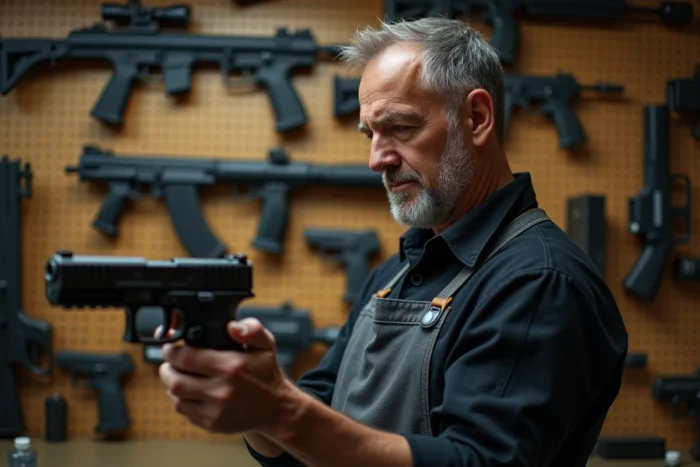
The Heckler & Koch P30L is the signature weapon of the first film. Its extended barrel offers better accuracy at medium range, which fits perfectly with the fight scenes in Wick’s house, and then in the Red Circle nightclub.
On the shooting set, this choice responds to a very concrete constraint. The P30L has a double action/single action trigger that allows Keanu Reeves to execute rapid shots and controlled shots without changing posture. For an actor who performs most of his action scenes himself, this mechanical detail changes everything: less time wasted repositioning, more fluidity on screen.
The P30L also returns in the second installment, but in a secondary role. Stahelski explained that the evolution of the arsenal reflects the escalation of the conflict. You don’t keep the same weapon when the stakes change.
Glock 26 TTI Combat Carry: the backup weapon that never leaves Wick
The Glock 26, modified by Taran Tactical Innovations, serves as a backup weapon throughout several films. Compact and concealable, it comes into play when Wick has lost his primary weapon or finds himself in unexpected close combat.
What makes this choice interesting is that the Glock 26 is not a spectacular weapon. It is a survival tool. Its recurring presence anchors the character in an operational logic: always have a plan B accessible in less than a second.
STI 2011 Combat Master and Taran Tactical: the arsenal of the third film
John Wick Parabellum marks a turning point in the arsenal. The flagship weapon of the third installment is the STI 2011 Combat Master, prepared by Taran Tactical Innovations (TTI). This pistol was specifically designed for the film, with modifications that do not exist on any production model.
The features chosen by the filming team respond to specific needs:
- An integrated compensator that reduces muzzle rise between shots, allowing Reeves to keep his target in frame during long takes.
- A flared magazine well to speed up reloads on screen, a gesture that Stahelski systematically films in close-up.
- Oversized sights, visible to the camera even during rapid movement, enhancing the readability of action scenes for the viewer.
The collaboration between TTI and the production had a direct effect on the real weapons market. The “John Wick custom” models have become sought-after references among sport shooters, a rare phenomenon for movie props.
Benelli M4 and assault rifles: adapting the weapon to the combat space
Handguns are not always sufficient. In sequences where Wick faces large groups in open spaces, Stahelski’s team introduces long guns. The Benelli M4, a semi-automatic shotgun, appears in several scenes of the second film, notably in the Roman catacombs.
The choice of the Benelli M4 is not decorative. Its semi-automatic rate of fire allows for filming close eliminations without editing cuts, where a traditional pump-action shotgun (manual reloading) would impose a visual pause between each shot.
In the fourth installment, AR-15 type assault rifles and a precision rifle also appear during the sequence in Paris. Each weapon transition corresponds to a change in the scale of the fight: corridor, room, urban exterior. It is this spatial logic that structures the writing of action scenes in the saga.
Improvised weapons and close combat
The franchise is not limited to firearms. The knife fight scenes in Parabellum (the showcase of bladed weapons), or the use of a book in the New York library, contribute to the same philosophy. Wick uses what is at hand, and this adaptability enhances the character’s tactical credibility.
Feedback varies on this point, but many martial arts practitioners and sport shooters believe that Reeves’ visible training on screen has helped make these transitions between firearms/bladed weapons/unarmed combat more natural than in most productions of the genre.
The John Wick saga has set a standard in action cinema by treating each weapon as a narrative choice, not as a visual effect. From film to film, Wick’s arsenal tells as much as the dialogues: the escalation of threats, the character’s isolation, his ability to adapt. It is the shooting constraints and tactical logic that dictate the armament, not the other way around.